Mama Questions
How Many Burp Cloths Do I Need?
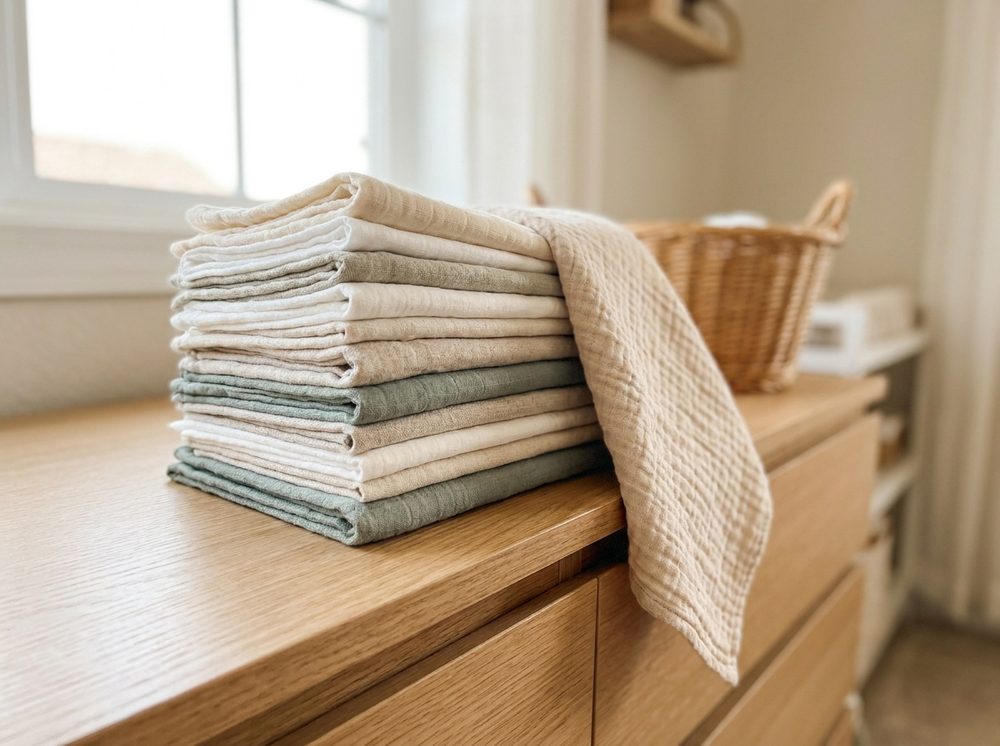
Ten-ish good ones, stationed where you actually feed — that's the whole system.
Quick answer: most families do well with 8–12 burp cloths — enough for one at every feeding spot plus a laundry buffer. If your baby turns out to be a heavy spitter, bump that to 15–20. Start with about 10 and adjust once you've met your baby.
Burp cloths are one of those registry items where the internet swings between "three is plenty" and "you'll need forty." The truth depends on exactly two things: how much your baby spits up (you won't know until they arrive) and how often you do laundry (you already know this about yourself). Here's how to land on your number — and the answers to everything else Mamas ask about burp cloths.
This post contains affiliate links. If you buy through them, we may earn a small commission — at no extra cost to you. We only point to things we'd actually tell a friend to get.
How to find your real number
Think in stations, not totals. You'll want burp cloths living at every place a feed happens: the nursing chair, your bed, the couch, the diaper bag. That's typically 4–6 "stationed" cloths. Then double it, because at any moment half of them are dirty, in the hamper, or mysteriously under the couch. That math lands most families at 8–12.
Two adjustments: if you wash laundry only once or twice a week, add a few. And if baby arrives and turns out to be a frequent spitter — some perfectly healthy babies just are — go straight to 15–20 and stop rationing. A multi-pack of muslin burp cloths is cheap insurance against doing laundry at midnight.
What makes a good burp cloth?
Absorbency and coverage — that's it. Multi-layer muslin or terry-backed cotton, big enough to actually cover your shoulder, is what you want. The thin, pretty cloths that match the nursery theme tend to soak through in one use. If you're choosing between cute and thick, choose thick.
Are cloth diaper prefolds really the best burp cloths?
For a lot of parents, yes — it's the classic veteran-Mama hack. Cotton prefold cloth diapers are thicker and more absorbent than most cloths sold as "burp cloths," cost less per cloth, and get softer with every wash. They're not Instagram-pretty. They are extremely good at their job.
Can I use receiving blankets or washcloths instead?
Absolutely. A folded muslin receiving blanket is an oversized burp cloth with better coverage — great for babies who spit up past the shoulder zone. Washcloths handle small dribbles fine. If you already own a stack of either, you may need to buy fewer dedicated cloths than you think.
How many should go on my registry?
Put about 10 on the registry — two multi-packs. It's a low-risk item people love to gift, and it covers the most likely scenario. Resist the urge to register for 25 "just in case"; storage space is real, and you can always add more with a couple of taps after baby arrives.
Where should I keep them?
Everywhere a feed happens. A small basket at the nursing chair, a couple on the nightstand for 3 a.m., one in the diaper bag, one near the bouncer. Scattered-but-stationed beats one beautiful pile in the nursery you'll never walk to mid-burp. This is the same logic as a good feeding station — we walked through the whole setup in our breastfeeding station essentials guide.
Stocking the changing table? Stock the freezer too.
Grab a free sample of our make-ahead meals for new Mamas — the dinner version of "enough burp cloths."
Get the free sample →How often should I wash them — and how do I get the smell out?
Every 2–3 days with the regular baby laundry is plenty. The sour-milk smell sets when cloths sit balled-up and damp, so give heavy ones a quick rinse before the hamper. For set-in smell or stains, a scoop of baby-safe oxygen bleach in a warm soak brings even grey, sad cloths back to life.
Do I need bibs too, or are burp cloths enough?
Different jobs, different timelines. Burp cloths protect you and work from day one. Bibs protect baby's clothes and earn their keep around 4–6 months when drool and solids begin. You can safely skip bibs at first and add a pack of drool bibs when the faucet turns on.
How long will we actually use them?
Usually the first 6–9 months. Spit-up tends to taper off as babies spend more time upright and start solids. The good news: quality burp cloths have a long afterlife as face wipers, high-chair cleanup rags, and change-pad liners. This is a buy-once item.
Is it normal for my baby to spit up this much?
Small, frequent spit-ups are common in healthy babies — laundry-wise annoying, medically often unremarkable. But we're a nutrition blog, not your baby's care team: questions about spit-up volume, discomfort, arching, or weight gain belong with your pediatrician or IBCLC. If your gut says "this seems like a lot," ask them — that's exactly what they're for, and no one will ever think you're overreacting.
What else do I need at the 3 a.m. feed?
The burp cloth is step one. Steps two and three: a big insulated water bottle with a straw (nursing thirst is real — drink to thirst, always) and a snack you can eat with one hand while the other holds a baby. We've written about what actually makes a good nursing snack and the handful of kitchen tools that keep you fed with zero free hands.
Should I buy everything before baby comes?
Buy your 10 and stop. Within two weeks you'll know whether you got a tidy eater or a champion spitter, and you can size up accordingly. Spend the saved money (and mental energy) on the thing that's harder to fix after birth: a freezer with real dinners in it.
The answers keep coming — every Tuesday
Real-Mama Q&A, recipes, and research in the Nourished Mamma Weekly. Try it for $1 your first month.
Try the Weekly for $1 →This article is educational and not medical advice. For decisions about your baby's feeding, spit-up, or your own nutrition and recovery, please talk to your pediatrician, healthcare provider, or an IBCLC. As an Amazon Associate we earn from qualifying purchases.